
If you are considering improving your home, the latest Bank of England rate increase may have made you pause.
On 5 November 2026, the Bank of England increased Bank Rate from 3.75% to 4%. At the same time, UK house price growth has slowed, with Nationwide reporting annual growth of just 0.5% in October 2026.
So, will the base rate going up affect your home value?
Potentially, yes. But the relationship is not as simple as “higher rates mean lower house prices”. Your home value depends on much more than interest rates, including location, condition, available space, energy efficiency, layout and what buyers are prepared to pay for a property like yours.
For homeowners in Bristol, that makes the decision about home renovations particularly important. If you are going to spend money improving your property, the aim should not simply be to make it more expensive. It should be to make the money you spend work harder by improving how the home functions, how attractive it is to future buyers and how well it suits the local market.
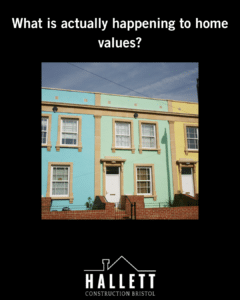
The first thing to understand is that home value is not determined by the Bank Rate alone.
Interest rates influence the cost of borrowing. When mortgage rates increase, some buyers may have less available income for a mortgage payment, reducing the amount they can afford to borrow.
MoneyHelper explains that mortgage rates are generally higher than Bank Rate and that borrowers on tracker or variable-rate mortgages can see their payments increase when Bank Rate rises. Those on fixed-rate mortgages are generally protected until their current deal ends.
That matters because the amount buyers can afford has a connection with property demand.
However, property is not a commodity with one fixed price.
Two houses on the same street can have very different values because one may have a better layout, an additional bedroom, a larger kitchen, improved energy efficiency, better outdoor space or more usable accommodation.
This is where sensible home renovations can make a difference.
A changing market does not automatically mean you should stop improving your home. It may mean you need to become more selective about which improvements you make.
There can be an indirect effect.
A higher base rate can make borrowing more expensive. If mortgage rates increase, buyers may reduce their budgets. If demand weakens, sellers may have to adjust their expectations.
The current figures show why homeowners should pay attention to the wider market. Nationwide reported UK annual house price growth of 0.5% in October 2026, the slowest rate since January 2024, while prices were unchanged month on month.
But this does not mean your home value will automatically fall.
In fact, improving the right aspects of your property can help it stand out when buyers have more choice.
Think about it from a buyer’s perspective.
If someone has a fixed budget and is comparing several Bristol properties, they may be more interested in a home that already has:
That is why the question is not simply whether interest rates will affect home value.
A better question is:
What improvements will make my home more useful and desirable without spending money that the property is unlikely to justify?

There is plenty of advice suggesting homeowners should renovate because it will automatically increase their home value.
That is too simplistic.
You can spend £50,000 on a renovation without adding £50,000 to the market value of your property.
The same applies to smaller projects.
A renovation can improve your experience of living in your home without producing a matching financial return. That does not necessarily make the renovation a bad decision, but it does mean you should understand the difference between adding value and adding enjoyment.
Another common mistake is assuming that bigger always means better.
A huge extension may look impressive, but if it consumes most of the garden, creates an awkward layout or pushes the property far beyond what buyers expect for the area, it may not be the best investment.
Likewise, removing a wall simply because open-plan living is fashionable may not produce the best result if the existing layout already works well.
The strongest home renovations usually start with the property itself.
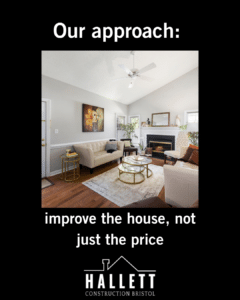
At Hallett Construction, the starting point for a renovation should be understanding what the property needs and what the homeowner is trying to achieve.
That might mean creating more usable space, improving the connection between rooms, adding another bedroom, modernising an outdated layout or making better use of an existing part of the property.
Hallett Construction is a Bristol-based building company providing services including extensions, conversions, knock-throughs, structural openings and planning and design.
The approach is particularly relevant when you are thinking about home renovations during an uncertain property market.
Instead of asking:
“What renovation will make me the most money?”
Consider:
“What improvement gives this house the greatest practical benefit while keeping the project sensible for the property and the budget?”
That distinction can help prevent unnecessary spending.
One of the first things to consider is whether your existing floor plan is working properly.
Many homes have accumulated awkward layouts over the years.
A kitchen may be separated from the main living space. A hallway may take up more room than necessary. A dining room might rarely be used. A rear room could be disconnected from the garden.
A structural knock-through can sometimes transform how a house functions without increasing its footprint.
Hallett Construction provides knock-through and structural opening services in Bristol, including work involving load-bearing walls and steelwork where required.
You can find more information about Hallett Construction’s knock-through and structural opening service.
The important point is not that every homeowner needs an open-plan layout.
It is that better use of existing space can sometimes deliver more benefit than simply adding more space.
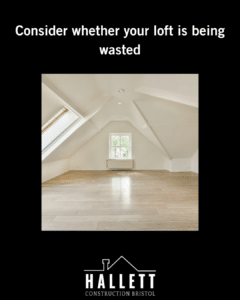
For some Bristol properties, the loft represents a significant amount of unused space.
A well-planned loft conversion can potentially create another bedroom, home office, dressing room or other useful accommodation without extending the building at ground level.
This can be particularly relevant where garden space is limited.
However, a loft conversion needs to be assessed properly. Head height, access, structural requirements, roof design, insulation, fire safety and planning considerations can all affect what is possible.
Hallett Construction provides loft conversion services in Bristol.
You can explore Hallett Construction’s loft conversion service.
Again, the objective should not simply be to add another room because more rooms sound better.
The objective is to create useful accommodation that makes sense for the property.
Extensions can be one of the most effective forms of home renovation, but they also require careful financial consideration.
A rear extension could create a larger kitchen and dining area.
A side extension could improve circulation or provide additional accommodation.
A wraparound extension could completely change how a property works.
But every extension has a cost.
You need to consider construction costs, professional fees, planning requirements where applicable, building regulations, heating and electrical changes, finishes and the effect on the rest of the property.
There is also the question of whether the finished property will remain appropriate for its location.
The best extension is rarely the one that simply adds the maximum possible floor area.
It is the one that solves a genuine problem.
One of the easiest ways to make home renovations more expensive is to begin work before the project has been properly considered.
Planning and design can help establish what you want to achieve before construction starts.
That can involve looking at the existing property, considering different layout options, understanding structural requirements and identifying potential issues before they become expensive changes during the build.
Hallett Construction offers planning and design support as part of its Bristol building services.
You can learn more about Hallett Construction’s planning and design service.
Good planning is not about making a renovation unnecessarily complicated.
It is about reducing avoidable surprises.
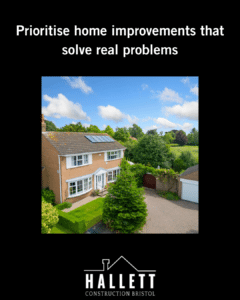
If the current economic environment makes you nervous about spending money on your home, prioritisation becomes even more important.
Ask yourself:
What is currently stopping this house from working properly?
It might be:
Start there.
This is generally more useful than choosing a renovation simply because it is popular.
For example, a carefully designed knock-through may completely change the way you use your home.
A loft conversion may provide the additional bedroom you need.
A modest extension may make the kitchen and dining area far more practical.
The value of these projects comes from solving a problem.
Independent customer feedback provides useful evidence about what homeowners can expect when working with Hallett Construction.
The company currently displays 60 Google reviews on its website.
One customer described the team as knowledgeable, experienced, professional and friendly, specifically highlighting communication and the quality of the work.
Another customer who had a load-bearing wall removed and an RSJ system installed described receiving a detailed, itemised quotation and praised the team’s efficiency, communication and care in keeping the site clean.
A separate review concerning a knock-through and external door opening noted that the work was completed in two days, with the team keeping the customer updated and returning after building control inspection to complete the final work.
Another Bristol homeowner described a complicated knock-through involving steel beams, noting that the work ran to time, the team kept the property tidy and communication was clear throughout.
These comments are particularly relevant to renovation projects because structural work is not simply about the finished appearance.
The process matters too.
Clear communication, realistic planning and coordination between different parts of the build can make a significant difference to the experience of renovating your home.
There are circumstances where renovating may not be the right decision.
If you are planning to sell very soon, for example, spending heavily on highly personal finishes may not produce the return you expect.
Likewise, if your finances are already under pressure because of mortgage costs, taking on a large renovation without a realistic budget could create unnecessary risk.
A renovation should also not be based on an assumption that property prices will definitely rise.
No builder can guarantee what your property will eventually sell for.
The property market can change, borrowing costs can change and buyer preferences can change.
What you can control is the quality of your decision-making.
That means understanding the scope, cost, practical benefit and likely appeal of the work before committing.
There is no universal list of improvements that will increase every property’s home value.
However, the following types of projects can be worth investigating where they address a genuine need:
| Renovation | Potential benefit | Key consideration |
|---|---|---|
| Knock-through | Improves flow and usable living space | Structural requirements |
| Loft conversion | Creates additional accommodation | Head height, structure and regulations |
| Extension | Adds usable floor space | Cost, planning and property proportions |
| Layout redesign | Makes existing space work harder | Design and structural implications |
| Garage conversion | Creates additional usable accommodation | Parking, insulation and regulations |
| Structural opening | Connects rooms or changes layout | Engineering and building control |
The important word is potential.
A renovation does not guarantee an increase in home value.
The result depends on the property, location, quality, specification, buyer demand and the amount invested.

If the property market feels uncertain, you do not necessarily need to sit still.
Instead, make your renovation decisions more carefully.
Are you improving the house because you want to stay for another 10 years?
Are you planning to sell?
Do you need another bedroom?
Do you want a better kitchen and living space?
Your answer will influence what makes sense.
Look at the layout rather than immediately looking at finishes.
The biggest opportunity may be structural.
Include the construction work and the associated costs rather than focusing only on the headline building price.
You might be able to solve the same problem through a knock-through, extension, loft conversion or internal reconfiguration.
The cheapest option is not always the best.
The most expensive option is not automatically the best either.
Structural work and larger renovations should be properly assessed before construction begins.
A clear plan can help you understand what is possible and what the project may involve
A home that works well for you is valuable even if the market takes longer to reward that investment.
It can put indirect pressure on property values because higher borrowing costs can reduce what some buyers can afford. However, your home value is affected by many factors, including location, condition, layout, size and demand.
It can, but there is no guarantee. The strongest renovations usually solve genuine problems, improve the usability of the property and make sense for the type of home and local market.
It depends on your circumstances. If you intend to stay in the property for several years and the renovation will substantially improve how you use the house, it may still make sense. If you are relying entirely on a quick increase in resale value, the decision requires more caution.
There is no single answer for every property. Extensions, loft conversions and layout changes can be valuable where they create genuinely useful accommodation or improve how the existing space works.
It can be, particularly when an existing layout prevents the home from being used efficiently. However, structural requirements, steelwork, building control and the resulting layout all need to be considered.
A loft conversion can be an effective way to create additional accommodation where the existing property and roof structure make it suitable. The feasibility and financial case should be assessed on an individual property basis.
That depends on the cost of moving, your mortgage position, the local property market and what you need from your home. If you already like your location, renovating may allow you to solve the problems that would otherwise make you consider moving.
There is no universal percentage that applies to every property. Your budget should reflect the property, the scope of work, your finances and whether the objective is long-term enjoyment, improved functionality or resale.
No. Renovations can improve a property’s appeal and functionality, but future selling prices depend on market conditions and buyer demand as well as the condition of the property.
So, will the base rate going up affect your home value?
It may.
Higher borrowing costs can affect affordability and demand, and the UK housing market is currently showing relatively modest price growth. The Bank of England’s latest decision has taken Bank Rate to 4%, while Nationwide reported annual house price growth of just 0.5% in October 2026.
But that does not mean homeowners should automatically stop improving their properties.
The better response may be to become more selective.
Instead of renovating because you think you should, identify what your home genuinely lacks.
If the layout is poor, investigate whether a structural change could solve it.
If you need more accommodation, investigate whether a loft conversion or extension is appropriate.
If your existing space is underused, consider whether better planning could make it work harder.
And before committing to a significant project, make sure the numbers and practical benefits make sense for your property.
Hallett Construction works with homeowners across Bristol on building projects including home renovations, knock-throughs, structural openings, loft conversions, extensions and planning and design.
If you are considering improving your Bristol home and want to understand what could be possible, the next step is straightforward.
Request a consultation or get a quick quote from Hallett Construction.