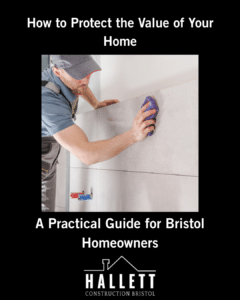
Protecting the value of your home starts with looking after the building, addressing maintenance problems before they become more serious and making improvements for the right reasons. For homeowners in Bristol, this may mean repairing existing defects, improving the layout, considering an extension or loft conversion, or deciding whether a knock-through would make the property more practical.
The important point is that not every home improvement increases a property’s market value by more than it costs. A carefully planned project can improve how you live in your home, but its financial return will depend on the property, the work undertaken, the quality of the finished result and the preferences of future buyers.
In this guide, we explain how to protect the value of your home through preventative maintenance, sensible investment and informed building decisions. We also explore when extensions, loft conversions and knock-throughs may be worth considering, and what Bristol homeowners should think about before committing to building work.
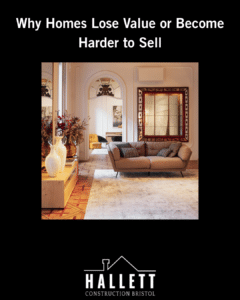
A property’s condition, layout and overall suitability all influence how potential buyers perceive it. Some problems are immediately visible, while others may only become apparent during a survey or closer inspection.
Deferred maintenance is a particular risk. A small defect can become more expensive if its underlying cause remains unresolved. For example, a leaking gutter may contribute to persistent damp around external walls. Simply repainting the affected area will not solve the problem if water continues to enter the building.
Other issues can affect how practical a home feels. Poorly arranged rooms, inadequate storage, limited usable space or an outdated layout may make it less suitable for a household’s needs.
It is important to distinguish between three different objectives:
These objectives overlap, but they are not identical. A repair may prevent further deterioration without directly increasing the sale price. A renovation may make your home considerably more enjoyable without returning its full cost when you sell.
Understanding the difference helps you decide where your money is best spent.

Homeowners are often encouraged to modernise their kitchens, replace bathrooms, create open-plan living areas or add another bedroom. These projects can make a property more appealing, but the advice is incomplete if it ignores the condition of the existing building and the cost of the work.
A high-specification kitchen may be attractive, but buyers have different tastes and budgets. A loft conversion may create valuable extra space, but only if the room is practical, accessible and appropriate for the property.
The same applies to an extension. Increasing floor space does not automatically mean the final property will sell for enough to recover the full cost of construction.
Before committing to major work, consider:
Fresh paint and new flooring can improve presentation, but they will not resolve an underlying roof leak, drainage problem or structural defect.
Historic England recommends understanding the cause of deterioration and addressing it rather than simply treating visible symptoms. Its guidance also emphasises regular inspections and appropriate repair methods, particularly for older properties.
Read Historic England’s guidance on maintaining and repairing your home.
Open-plan living works well for some households, but others prefer separate rooms for working, relaxing or accommodating family members. Similarly, converting every available space is not necessarily the right decision.
The objective should be to improve the property in a way that suits its layout, condition and intended use, rather than following a trend without considering the consequences.
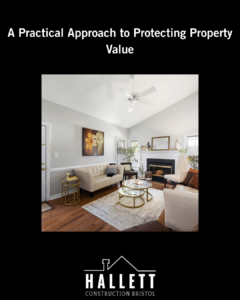
A useful way to approach home improvements is to separate essential maintenance from optional upgrades and larger building projects.
Start by understanding the property’s condition. Next, prioritise repairs and establish a realistic budget. Only then should you decide whether more substantial improvements are appropriate.
This approach can help homeowners avoid spending heavily on visible upgrades while neglecting problems that may be more urgent.
For homeowners in Bristol, the same principle applies whether the property is a traditional terrace, a semi-detached family home or a more recently built house. The right course of action depends on the individual building, not simply its property type or postcode.
Begin with a practical inspection of the home’s visible condition. Look at the roofline, gutters, external walls, windows, doors, drainage and internal areas where signs of damp or damage may appear.
A basic inspection can help identify issues that deserve further investigation. It cannot replace a professional survey or specialist assessment where there are signs of structural movement, persistent damp or other potentially serious defects.
Create a list of issues and separate them into urgent repairs, routine maintenance and optional improvements. This helps you allocate your budget according to need rather than appearance alone.
For older properties, take particular care when choosing repair methods and materials. Historic England’s guidance on maintaining and repairing traditional buildings explains why repairs should be suitable for the building’s construction and character.
Water-related problems deserve attention because the visible damage may be only part of the issue.
Check for blocked or leaking gutters, damaged roof coverings, defective seals around openings and drainage problems. Look for persistent damp patches, deteriorating plaster, damaged external finishes or timber that appears to be decaying.
Do not assume that every damp problem has the same cause. Condensation, penetrating moisture and other forms of damp require different responses. Identify the underlying issue before committing to repairs or replacement materials.
Where you suspect a serious defect, seek an appropriate professional assessment. Dealing with the cause early can help prevent further damage and potentially more extensive remedial work.
A comfortable, energy-efficient home can be attractive to current and future occupants. However, improvements need to be suitable for the building and its construction.
Consider whether loft insulation, draught reduction, heating controls or other measures might improve comfort and reduce energy consumption. Before undertaking substantial work, investigate the likely cost and suitability of the proposed measures.
The UK Government’s Find Ways to Save Energy in Your Home service provides recommendations for properties in England and Wales, including estimated improvement costs and potential energy-bill savings.
These estimates are not guarantees, and energy-efficiency improvements should not automatically be treated as a promise of higher resale value. Their immediate benefits may instead include improved comfort, reduced energy use or addressing an existing deficiency.
A home does not always need more floor space. Sometimes, the available space simply needs to work better.
For example, a poorly arranged kitchen and dining area may benefit from a different layout. A bedroom might need better storage, or a ground-floor room might be more useful if its access and arrangement were improved.
Think about how you and your household use the property now, as well as how a future buyer might perceive the space.
Before removing walls or altering room arrangements, establish whether the proposed change is structurally feasible. Some walls support loads, and structural alterations can require professional design, suitable supports and building regulations approval.
An extension may be worth investigating if you need more living space, a larger kitchen or an additional room but want to remain in your current home.
However, the right decision depends on the property, the available space, the project budget and the practical implications of construction.
Consider the following before proceeding:
Hallett Construction provides building services in Bristol, including extensions and other home improvements. Reviewing the relevant service information can help you understand the type of work to discuss when you are ready to explore your options.
An extension should be planned around a clear purpose. More space may improve your enjoyment of the home, but the financial return will depend on the circumstances of the property and the project.
A loft conversion can make use of space that might otherwise remain underused. Depending on the building, it may provide a bedroom, bathroom, home office or additional living area.
Before considering a loft conversion, investigate the available headroom, roof structure, access, insulation, ventilation, fire-safety requirements and any necessary permissions. The feasibility and cost can vary significantly between properties.
It is also worth comparing a loft conversion with other ways of improving the home. A conversion may be attractive if you need another bedroom but want to preserve the garden. An extension might be more appropriate if your priority is a larger kitchen or additional ground-floor living space.
For local information, see Hallett Construction’s loft conversion service in Bristol.
A knock-through can change how rooms connect, improve movement through the home and create a more open living area.
It can be useful where a property’s existing layout feels restrictive. However, removing a wall is not simply a cosmetic change. Depending on the structure, it may involve load-bearing walls, structural calculations, steel supports and building regulations requirements.
Before committing, consider whether the new layout will genuinely improve the home. Think about natural light, noise, privacy, heating, furniture arrangements and whether you might lose useful separate living space.
Obtain appropriate professional advice before structural work begins. You can explore Hallett Construction’s building contractor services in Bristol as a starting point for discussing a potential project.
Good records help you understand what has been done to the property and can be useful when arranging future repairs, maintenance or a sale.
Keep relevant documents together, including:
Do not assume that a previous owner’s alterations were approved simply because the work looks finished. If you are planning further work, establish what documentation exists and whether any outstanding issues need attention.
Protecting the value of your home in Bristol starts with understanding the property you own and the local context in which it sits.
Homes vary considerably in age, construction, layout and condition. A maintenance approach that is suitable for one property may not be appropriate for another, particularly where older buildings or traditional materials are involved.
If your property is older, take care when choosing repair methods. Historic England notes that some buildings need materials and techniques suited to their original construction. Listed buildings and properties in conservation areas may also be subject to additional requirements. Check the relevant guidance before undertaking work.
For Bristol homeowners considering an extension, loft conversion or knock-through, it is sensible to establish what the property can accommodate before deciding on a particular design. Consider the existing structure, available space, access, natural light, drainage and the impact on the rest of the home.
You should also distinguish between planning permission and building regulations. They serve different purposes, and the requirements depend on the proposed work and the property.
The official GOV.UK planning permission guidance and building regulations approval guidance are useful starting points.
Hallett Construction is a Bristol-based building company offering extensions, loft conversions, knock-throughs and other building services. If you are considering a project, its building services page is a relevant place to explore the available options.
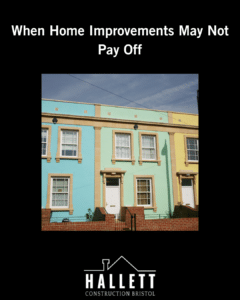
Not every improvement is worthwhile from a financial perspective. Before committing to a project, consider the possible benefits and limitations.
Routine maintenance helps protect the building’s condition, but some issues require specialist investigation rather than a quick repair.
Energy-efficiency improvements may improve comfort and reduce energy bills, but installation costs, suitability and actual savings vary.
An extension creates additional living space, but you should consider construction costs, outdoor space, disruption and local market demand.
A loft conversion makes use of existing roof space, but headroom, structure, access, safety requirements and project costs can affect feasibility.
A knock-through can improve the layout, but structural requirements, noise, privacy and the loss of separate rooms all need consideration.
Cosmetic renovation refreshes the appearance of a property, but personal tastes differ and the cost may not be recovered at resale.
A useful rule is to separate essential work from optional work.
If the roof needs attention, addressing that problem may be more important than installing a new kitchen. If the home is structurally sound but the layout no longer meets your needs, a carefully planned alteration may be worth investigating.
Also consider the possibility of over-improving. A major renovation may be entirely justified because you intend to live in the property for many years, even if the eventual sale price does not cover every pound spent. Equally, a project undertaken solely to increase resale value deserves a careful assessment of costs, alternatives and uncertainty.
The objective is not to avoid spending money on your home. It is to spend it for reasons that make sense.
Start with regular maintenance, address defects promptly and keep the property in good condition. When considering improvements, focus on what the home needs and whether the proposed work is suitable for the building and your budget.
Improvements that create practical, usable space may be attractive to buyers. Extensions and loft conversions can be worth investigating, but the outcome depends on the property, location, construction cost and quality of the finished work. No particular improvement guarantees a financial return.
A well-planned loft conversion can create additional usable space and may improve a property’s appeal. The effect on market value depends on the property, the quality of the work, local buyer demand and the cost of the project. It should not be treated as a guaranteed financial return.
A knock-through may improve the layout and make a home more practical. Whether it is worthwhile depends on the existing rooms, structural requirements, cost and how the resulting space will be used. Obtain appropriate professional advice before removing a wall.
Not necessarily. Addressing obvious maintenance problems and making the property presentable may be sensible, but major renovations are not always justified immediately before a sale. Consider the likely cost, the time available and whether the work is likely to meet the expectations of potential buyers.
Energy-efficiency improvements may make a property more comfortable and reduce energy consumption. Their impact on market value varies, so it is better to evaluate the practical benefits and costs of each measure rather than assume a guaranteed resale premium.
It depends on the work and the property. Some projects can be carried out under permitted development rights, while others require planning permission. Building regulations may apply separately. Check the relevant requirements before work starts.
Consider the space you need, the existing layout, the roof structure, the available outdoor area, the project budget and the disruption involved. A property-specific assessment can help establish which options are feasible before you commit to a design.
The appropriate schedule depends on the building, its condition and any known maintenance concerns. Routine visual checks and prompt attention to problems can help identify defects before they become more extensive. Older properties may need particular care and maintenance planning.
If you are considering an extension, loft conversion, knock-through or other building project, you can contact Hallett Construction to discuss your plans and explore the relevant building services.

Protecting the value of your home is about more than following renovation trends or spending money on the most visible parts of the property.
Regular maintenance, early attention to defects and suitable repair methods help look after the building you already own. When improvements are appropriate, a carefully planned extension, loft conversion or knock-through may make the home more functional and appealing, but the financial outcome will always depend on the individual circumstances.
For homeowners in Bristol, the most sensible starting point is to understand the condition of the property, identify what needs attention and establish which improvements genuinely meet your needs.
If you are considering building work, Hallett Construction can help you explore options for your property.
Planning to improve your home?
Contact Hallett Construction to discuss your ideas for an extension, loft conversion, knock-through or other building project in Bristol.
Contact Hallett Construction to take the next step.