A good garden should make you want to use it.
Not just for the two weeks of sunshine we might get in Bristol, but throughout the year.
Somewhere for a coffee in the morning. Somewhere the children can play. Somewhere you can have friends over without dragging chairs across a patchy lawn. Somewhere that still looks tidy when November arrives and Bristol has had rain for what feels like three weeks solid.
That is where good Bristol landscaping designs make a difference.
The best gardens are not necessarily the biggest or the most expensive. They are the ones where the layout, materials, levels, drainage and practical details have all been thought about before the work starts.
If you are considering changing your garden, here is what is worth thinking about before you start buying paving slabs or saving pictures of perfect gardens.
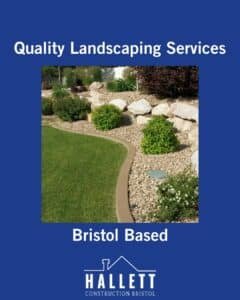
A good landscaping design starts with one simple question:
It sounds obvious, but it is easily missed.
There is little point creating an enormous patio if you only need enough space for a table and six chairs. Equally, keeping a large lawn because it was already there makes little sense if nobody uses it.
Before looking at colours or paving styles, think about what you want from the space.
That might include:
Once those priorities are clear, the landscaping design becomes much easier.
The RHS also recommends mapping the garden properly before committing to a design. A scale plan helps establish the true shape, existing features, doors, windows and sunlight, while also helping calculate material quantities. It is considerably easier to change a pathway on paper than after it has been laid.
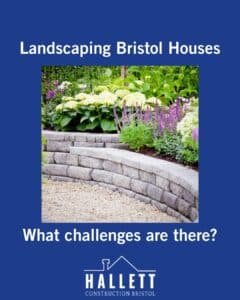
Anyone who has spent time looking at houses around Bristol will know there is no such thing as a standard Bristol garden.
You can go from a long, narrow Victorian terrace garden in Bedminster to a larger family garden in Stoke Bishop, a steep plot around Totterdown or a more modern garden around Emersons Green.
That means Bristol landscaping designs need to respond to the property rather than follow a standard template.
Common behind Bristol’s terraces, narrow gardens can feel smaller than they really are when everything runs in straight lines from the back door to the fence.
Breaking the garden into purposeful areas can make the space feel much more considered.
A patio near the house, planting or raised beds through the middle and another seating area towards the back can give the garden several uses without making it cluttered.
A slope is not necessarily a problem.
Handled properly, changes in level can become one of the strongest features in the finished garden.
Steps, retaining walls and terraces can turn an awkward slope into separate usable areas.
The important part is getting the construction right.
Retaining walls need to do considerably more than look attractive. Foundations, drainage and the loads behind the wall all need to be considered.
Small gardens benefit most from restraint.
Trying to fit every idea into a limited space usually makes the garden feel even smaller.
A few well-defined areas, consistent materials and good planting generally work better than trying to squeeze in a long list of features.
The patio is usually where homeowners start when thinking about landscaping.
And understandably so.
It connects the house with the garden and tends to become the area that gets used most.
But a patio should not be designed in isolation.
Think about:
Put a table and chairs on paper and allow enough room to comfortably move around them.
If you regularly entertain, allow for additional seating.
The obvious position immediately outside the house is not always the best place for every seating area.
You might find the far end of the garden catches the evening sun.
That can justify having a main patio by the house and a smaller seating area elsewhere.
This is one of the less exciting questions, but one of the most important.
Water needs somewhere sensible to go.
The RHS notes that poor drainage can cause persistent surface water and that drainage work needs to consider where surplus water will discharge.
That is particularly relevant when replacing lawns and borders with larger areas of hard landscaping.
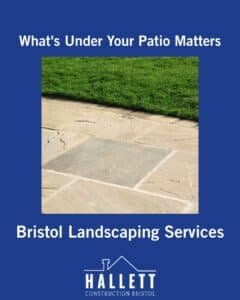
This is where our construction background changes the way we look at landscaping.
You can buy beautiful paving.
You can choose the perfect colour.
You can spend hours deciding between porcelain and natural stone.
None of it matters much if the preparation underneath has been rushed.
Good paving depends on:
These are the bits you stop seeing once the garden is finished.
They’re also the bits that determine how well it performs afterwards.
At Hallett Construction, our new Bristol landscaping services have been built around the same principle we apply to construction work across the city: do the preparation properly and build something that lasts.
This is one of the most common choices homeowners face when looking at Bristol landscaping designs.
Neither is automatically better.
They simply create different results.
Porcelain has become extremely popular in contemporary gardens.
It provides a clean, consistent finish and works particularly well where homeowners want the garden to feel like an extension of a modern interior.
It is available in a huge range of colours and finishes.
Natural stone gives a softer, more traditional appearance.
Variations in colour and texture are part of its appeal and can work particularly well with Bristol’s older properties.
The right choice depends on the house, garden and look you are trying to achieve.
Try not to choose paving purely because you have seen it in somebody else’s garden.
It needs to suit yours.
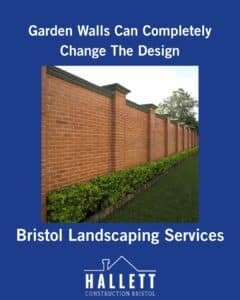
Garden walls are sometimes treated as purely functional.
They shouldn’t be.
Brickwork can introduce structure, height and character into a garden.
It can be used for:
For older Bristol properties, matching brickwork with the house can make new landscaping feel as though it has always belonged there.
For more contemporary gardens, contrasting brick or rendered walls can provide much stronger definition.
Hallett Construction has a strong brickwork background, which is particularly useful when a landscaping project includes structural walls, retaining features, steps or changes in level. Our landscaping service covers these elements alongside patios, paving, paths and groundwork.
One of the quickest ways to spot poorly planned landscaping is awkward levels.
A step where you don’t expect one.
A patio sitting too high against the house.
A pathway with an uncomfortable slope.
A lawn that never quite meets the paving properly.
Good Bristol landscaping designs resolve levels before finishes are chosen.
This is especially important on sloping sites.
Sometimes the better solution is not fighting the slope but using it.
A garden can be divided into terraces with steps connecting each level. The result often gives the space much more character while creating genuinely usable areas.
Nobody gets particularly excited about garden drainage.
Until their new patio is covered in water.
Drainage needs to be considered alongside the levels and paving design, not after everything else has been installed.
Water naturally follows gravity, so the design needs to control where it goes.
That can involve falls, permeable areas, drainage channels, planting beds or other appropriate drainage solutions depending on the site.
The RHS warns that non-permeable hard surfaces can significantly increase rainwater run-off, which is why permeability and water management deserve consideration during the design stage rather than once the garden is complete.
Low maintenance does not have to mean paving everything.
Some of the best gardens balance hard landscaping with softer areas.
Think:
Patio.
Planting.
Lawn.
Brickwork.
Fencing.
Paths.
They all have different jobs.
Hard landscaping provides structure. Planting softens it.
Even if you want a relatively low-maintenance garden, leaving space for planting can make a substantial difference to how established and welcoming the finished garden feels.
There is no point pretending we live on the Mediterranean.
A Bristol garden needs to work when it rains.
Surfaces should remain practical.
Steps should be safe.
Water needs somewhere to go.
Paths should allow you to reach bins, sheds and gates without crossing a muddy lawn.
The best landscaping designs are often the ones you appreciate most in January rather than July.
If the garden still works when the weather is poor, it has probably been designed properly.
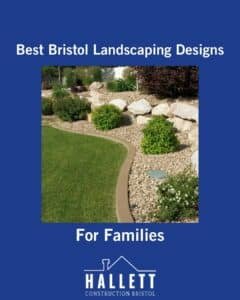
For a busy family home, simplicity usually wins.
You want enough structure that different activities can happen without making the garden feel divided into tiny sections.
A practical family layout might include a generous patio close to the kitchen, a central lawn or open area, secure boundaries, practical paths and planting around the edges.
If there are young children, visibility from the house matters.
If you entertain regularly, access between the kitchen and outdoor dining area becomes more important.
If everyone is getting older and the climbing frame is disappearing, perhaps that part of the garden can become a seating area, raised beds or something you will use more often.
A garden should be designed around your life now, with enough flexibility to change later.
Front gardens deserve more attention than they usually receive.
They are the first thing you see when you come home and the first impression visitors get of the property.
Good front garden landscaping might include:
If you are replacing planting with hard surfacing, drainage becomes particularly important.
For front gardens, planning rules can also apply to impermeable surfaces in certain circumstances, so this is something worth checking before committing to the design. The RHS provides useful guidance on permeable paving and front gardens.
There isn’t a useful single answer.
A garden that needs a patio and a few straightforward improvements is a very different project from one involving excavation, retaining walls, multiple levels, fencing, drainage and extensive paving.
The main factors affecting landscaping costs include:
This is why a proper site visit matters.
A cheap square-metre paving figure tells you very little if the ground underneath needs significant preparation.
Price matters.
Of course it does.
But landscaping is one of those jobs where shortcuts often don’t become obvious immediately.
A patio can look fantastic on the day it is finished.
Problems tend to appear later.
Movement.
Poor drainage.
Loose slabs.
Cracking.
Unstable walls.
Water sitting where it shouldn’t.
The preparation underneath determines whether the finished work stays looking good.
That is why comparing landscaping quotes purely on the final figure can be misleading.
Look at what is actually included.
Ask about excavation.
Ask about the sub-base.
Ask about drainage.
Ask how walls will be constructed.
Ask how levels will be managed.
A professional landscaper or construction team should be comfortable explaining all of it.
Landscaping is a natural fit for the work we already do.
A lot of what homeowners call landscaping is actually construction outside the house.
Groundworks.
Brickwork.
Walls.
Foundations.
Drainage.
Steps.
Paving.
Levels.
Those are areas our team already understands.
Our landscaping services in Bristol are aimed at homeowners who want more than a quick garden makeover.
We want the finished garden to look right, but we care just as much about what is underneath it.
Hallett Construction’s existing customer feedback regularly highlights the team’s communication, workmanship, efficiency and how sites are left at the end of the day. Those are exactly the standards we are carrying into landscaping projects across Bristol.
We work with homeowners across Bristol and the surrounding areas, including:
North Bristol: Bishopston, Horfield, Filton, Stoke Gifford, Bradley Stoke, Westbury-on-Trym and Henleaze.
South Bristol: Bedminster, Southville, Knowle, Brislington, Hengrove, Whitchurch and Stockwood.
East Bristol: Fishponds, Downend, Staple Hill, Kingswood, Hanham, Longwell Green and Emersons Green.
Central and West Bristol: Clifton, Redland, Cotham, Stoke Bishop, Sneyd Park and surrounding areas.
Every garden is different, which is exactly why the starting point should be the property rather than a standard landscaping package.
Start with how you want to use it. Decide what needs to stay, what frustrates you about the current garden and which areas you would genuinely use. Once that is clear, the patio, paths, walls, levels and planting can be planned around those priorities.
Not every project needs a formal landscape architect. Straightforward patios, paths, walls and garden alterations can often be planned directly with an experienced team. More complex sites may benefit from detailed plans before construction starts.
The cost depends on the size of the garden, materials, access, excavation, drainage and complexity. A simple patio is very different from a complete garden transformation involving retaining walls, steps and significant groundwork. A site assessment gives a much more useful figure than a generic online estimate.
Yes. Sloping gardens can often be transformed using retaining walls, steps and changes in level to create flatter, more usable sections. Drainage and the construction of retaining features need careful consideration.
Hard landscaping covers the constructed elements of the garden, including patios, paving, paths, walls, steps, retaining structures and similar permanent features. These elements normally form the structure of the overall garden design.
Very. Levels and drainage should be considered before paving or other finishes are installed. Poor water management can cause standing water and affect both the usability and longevity of the finished landscaping. The RHS provides further guidance on garden drainage and when additional drainage may be necessary.
If you’re planning a garden project, these are the questions worth answering next:
A detailed look at patios, groundwork, brickwork, access, drainage and the factors that influence the final price.
A homeowner’s guide to appearance, maintenance, durability and choosing paving that suits the property.
Ideas for levels, retaining walls, steps and making awkward Bristol gardens easier to use.
What actually matters when improving outdoor space and where spending more does, and doesn’t, make sense.
How to recognise poor drainage before installing new paving and why fixing the underlying issue first matters.
Practical ways to reduce ongoing work without turning the entire garden into paving.
If your garden has become the part of the house you keep putting off, start with what isn’t working.
Maybe the patio has seen better days.
Maybe the slope makes half the garden unusable.
Maybe you want somewhere you can actually sit, eat and enjoy when the weather behaves.
Or perhaps it simply needs someone to look at the whole space and work out how the pieces should fit together.
Our Bristol landscaping services cover patios, paving, brickwork, garden walls, steps, paths, groundworks, levels and larger garden projects.
Tell us what you want to change, and we’ll help you work out the right way to build it.