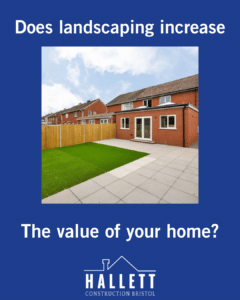
If you are considering landscaping in Bristol, it is reasonable to ask whether the work will add value to your home.
The short answer is it can, but there is no fixed amount that landscaping will add to every property.
A well-planned garden can make a home more attractive to buyers, create useful outdoor space and improve how the property feels as a whole. But the value of the work depends on the garden, the property, the quality of the finished result and what buyers in that area are looking for.
There is also a practical point that is easy to overlook. Good landscaping is not just about choosing paving, planting or creating an attractive seating area. Patios, paths, walls, steps and changes in level all depend on the preparation underneath them.
That is particularly important when looking at landscaping in Bristol, where gardens can vary considerably in size, access and level.
If you are considering landscaping in Bristol because you want to improve your home’s value:
The main point is simple: landscaping should improve the way the garden works as well as the way it looks.
It can, but it is better to think about landscaping as one part of the overall property rather than an investment with a guaranteed financial return.
The garden is part of the home. When buyers view a property, they are not only looking at the number of bedrooms or the condition of the kitchen. They are also considering how they would use the outside space.
A garden that is difficult to access, poorly drained or dominated by an old, uneven patio may make a property feel less appealing.
On the other hand, a garden with a sensible layout, usable patio, clear paths and well-managed levels can make the outside of the property easier to understand and use.
That does not mean you can spend £20,000 on a garden and expect the house to increase in value by £20,000.
Property prices are affected by many things, including location, size, condition, layout and the wider market.
For context, the Office for National Statistics reported an average Bristol house price of £357,000 in June 2026, with prices varying substantially by property type. The average was £696,000 for detached properties, £452,000 for semi-detached properties, £388,000 for terraced properties and £246,000 for flats and maisonettes.
That variation is important.
The right landscaping for a large detached house may not make sense for a small terraced property. Equally, a relatively simple improvement can make a significant difference to how a smaller garden is used.
So rather than asking:
“How much value will landscaping add?”
A better question is:
“Will this work make the property more useful and attractive without spending more than the improvement is likely to justify?”
What buyers actually notice about a garden
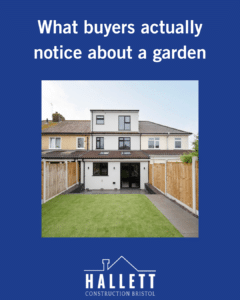
There is a tendency to think that adding expensive materials or creating a highly designed garden will automatically make a property worth more.
It is not that straightforward.
For many homeowners, the useful improvements are often quite simple.
A garden may benefit from:
The important word is usable.
A garden does not have to be enormous or expensive to work well.
For example, a relatively modest Bristol garden may be improved by replacing an awkward patch of lawn with a properly laid patio and creating a clear route to the rest of the garden.
A sloping garden may benefit more from well-planned steps, retaining walls and different levels than from simply trying to create one large flat area.
The right solution depends on the garden itself.
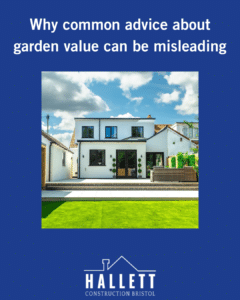
You will find plenty of claims online suggesting that a garden can add a particular percentage to a property’s value.
These figures should be treated carefully.
For example, Rightmove has published research showing that homes advertised with south-facing gardens have achieved higher average asking prices than comparable homes without them. One study of almost 400,000 three- and four-bedroom listings found a 7% asking-price difference nationally. A later analysis found an average 4% asking-price premium for homes with south-facing gardens, rising to 5% in the South West.
Those figures are useful evidence that outdoor space and garden characteristics can matter to buyers.
But they do not prove that spending a certain amount on landscaping will increase your home’s value by a particular percentage.
There is a difference between:
These are not the same thing.
That is why we would be cautious about landscaping purely because somebody has promised a specific return.
At Hallett Construction, the approach to landscaping in Bristol comes from a construction background.
That matters because many garden projects involve more construction than people initially expect.
A patio needs excavation and a suitable base.
A garden wall needs proper support.
A change in level needs to be considered before steps and paving are installed.
Drainage needs to be considered before the finished surfaces are in place.
This is why the visible part of a landscaping project is only part of the job.
The company’s Bristol landscaping service covers patios, paving, garden walls, brickwork, steps, paths, groundworks, changes in level and larger garden projects.
The basic approach is straightforward:
Look at how the garden needs to work, understand what is underneath it, then decide what should be built.
That is more useful than choosing materials first and trying to make the garden fit around them.
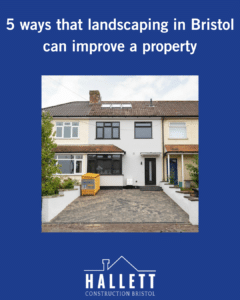
A garden that looks large on a plan is not necessarily easy to use.
An awkward patio, narrow access route or poorly positioned steps can make a garden feel smaller than it actually is.
Good landscaping can divide the space into areas with clear purposes.
For example:
The objective is not necessarily to add more features.
It is to make better use of the space that already exists.
Changes in level are common in gardens, particularly where the site slopes.
If the levels are poorly connected, part of the garden may become difficult to use.
Steps, retaining walls and carefully planned transitions can make the space easier to move around.
Hallett Construction specifically provides landscaping work involving steps, changes in level and retaining features.
For a sloping garden, this can be more important than choosing an expensive paving material.
The garden is often visible before a buyer has seen the inside of the house.
A tidy, practical outside space can therefore contribute to the overall impression of the property.
That does not mean everything needs to look brand new.
A well-maintained garden with sensible proportions and a clear layout can be more useful than an expensive garden filled with features that require significant maintenance.
Some landscaping projects are less about adding features and more about fixing problems.
These might include:
Solving these problems can make a garden feel more complete.
This is also why groundwork and drainage should be considered early rather than treated as an afterthought.
The best landscaping usually makes sense in relation to the property.
A contemporary home may suit clean, simple paving and clearly defined areas.
An older Bristol property may suit natural stone or brickwork that works with the existing building.
Hallett Construction’s landscaping guidance highlights the choice between porcelain and natural stone, with the right option depending on the house, garden and appearance you are trying to achieve.
There is no single material that is right for every garden.
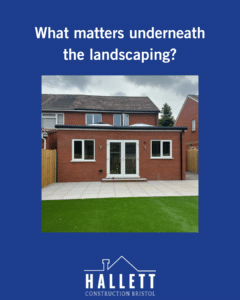
This is one of the most important points when comparing landscaping services in Bristol.
A finished patio can look excellent when it is first installed.
But what happens underneath it will affect how it performs later.
For paving, the preparation may involve:
These stages are not particularly visible once the garden is finished.
They are nevertheless important to the result.
The same principle applies to garden walls, steps and changes in level.
This is one reason it can be misleading to compare landscaping quotes by looking only at the final figure.
Two quotes can look very different because they include different amounts of preparation or construction.
If you are comparing companies, start with the work rather than the sales pitch.
Ask what is actually included.
Ask whether excavation, sub-base work, drainage and levels are included where required.
If the project involves walls, retaining features or steps, ask how these will be constructed.
A company should be able to explain how the different parts of the project work together.
A difficult garden can take considerably more preparation than an easily accessible one.
This is particularly relevant in Bristol, where properties can have narrow access, rear gardens, slopes and changes in level.
If the project involves substantial brickwork, walls or structural garden features, it makes sense to choose a company that regularly works with those materials and types of construction.
Hallett Construction has an established building and brickwork service alongside its landscaping work, including garden walls, decorative brickwork, paths and external works.
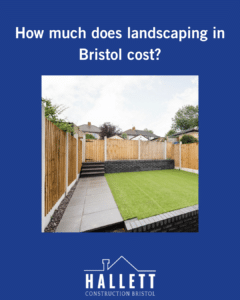
There is no useful single price for landscaping in Bristol.
The cost can change significantly depending on:
A simple patio and a complete garden transformation are very different projects.
Hallett Construction’s own landscaping guidance states that garden size, access, materials, groundwork and the amount of construction involved all affect the cost.
That is why a proper assessment is more useful than relying on a generic price-per-square-metre figure.
Landscaping is not automatically a good financial decision.
There are situations where spending heavily on the garden may not make sense.
For example:
A very expensive garden may not make financial sense if surrounding properties have much simpler outdoor spaces.
That is fine if you plan to stay in the property.
But if resale value is the priority, very personal features may not appeal to everyone.
A garden that looks impressive but requires constant maintenance may not be attractive to every buyer.
There is little point installing expensive paving if the underlying drainage or levels have not been properly considered.
If the roof, windows, kitchen, bathroom or general condition of the house need significant work, landscaping may not be the first place to spend money.
The best decision depends on the property as a whole.
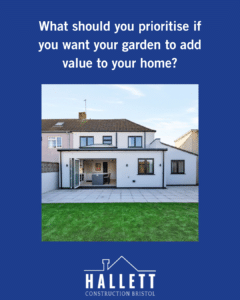
If resale is part of your decision, focus on improvements that are likely to make the garden easier to understand and use.
A sensible order might be:
Deal with drainage, broken surfaces, unsafe steps or failing walls.
Make it easy to move between the house and the garden.
Add or improve patios, paths and seating areas where they make sense.
If the garden slopes, make the changes deliberate rather than trying to hide the problem.
The garden should look like part of the home rather than something added without considering the building.
Avoid adding features simply because they are fashionable.
The result should work for the people using the garden now and remain reasonably appealing if the property is sold later.
Hallett Construction is an established Bristol building company with more than ten years of experience in the building trade and a particular focus on brickwork. Its wider services include extensions, conversions, structural openings and external building work.
That background is relevant to landscaping projects involving more than planting and surface-level changes.
The company’s landscaping service covers garden walls and fencing, steps and changes in level, groundworks and preparation, paths and hard landscaping.
The company website also displays 60 Google reviews, with customer comments covering communication, project management, tidiness and completing work as agreed. These reviews relate to the wider building service rather than providing a separate landscaping performance statistic, so they should be viewed in that context.
That distinction matters.
Good reviews are useful evidence of customer experience, but they do not guarantee a particular result for every landscaping project.
The best landscaping decisions usually involve a balance.
You may want the most attractive paving, but it may not be the most practical option for your budget.
You may want a large patio, but increasing the paved area could reduce planting or lawn space.
You may want to flatten a sloping garden, but creating retaining structures and moving large amounts of soil can add considerably to the cost.
You may want a low-maintenance garden, but some low-maintenance materials can have a higher initial cost.
There is no universal answer.
A good landscaping project starts by understanding what matters most to you and what the garden can realistically accommodate.
It can improve a property’s appeal and usability, but there is no guaranteed amount that landscaping will add to a home’s value. The result depends on the property, location, garden and quality and suitability of the work.
There is no single feature that guarantees the highest return. Practical improvements such as a usable patio, good access, sensible levels, sound drainage and well-maintained boundaries can make a garden more useful and appealing.
A properly designed and constructed patio can make a garden easier to use. Whether it represents good financial value depends on the property, size of the patio, materials and overall cost of the project.
Research from Rightmove has found higher average asking prices for properties advertised with south-facing gardens. However, these figures should not be treated as a guaranteed increase in value caused by the garden itself.
It can be, particularly if the existing garden has obvious problems such as broken paving, poor access, drainage issues or an unusable layout. Expensive landscaping purely for resale is less straightforward and should be considered alongside the rest of the property.
There is no standard price because costs depend on the garden size, access, materials, groundwork, drainage, levels and amount of construction involved. A site assessment is more useful than relying on a generic figure.
Yes. Sloping gardens can often be divided into more usable areas using steps, retaining walls and carefully planned changes in level. Drainage and the construction of retaining features need to be considered before the visible landscaping is completed.
Hard landscaping refers to constructed garden features such as patios, paving, paths, garden walls, steps and retaining structures. These elements often form the main structure of the garden.
Drainage is important because water needs to be managed before finished surfaces are installed. Poor drainage can lead to standing water and affect how well a garden can be used.
Look at what each company actually includes. Ask about preparation, drainage, levels, foundations, access and materials rather than comparing quotes purely on the final price. It is also worth checking whether the company has relevant experience with the type of construction your garden requires.
Landscaping in Bristol can make a home more attractive and potentially support its value, but it should not be treated as a guaranteed financial return.
The strongest reason to improve a garden is usually that it makes the property better to live in.
A well-planned garden can give you somewhere to sit, entertain, walk through, relax and use throughout the year. If you eventually sell, those same qualities may make the property more appealing to buyers.
The key is not to spend as much as possible.
It is to spend sensibly on the things that matter: layout, access, levels, drainage, materials and proper preparation.
For more substantial projects, especially where patios, paving, walls, steps or groundworks are involved, it is worth looking beyond the finished appearance and understanding how the garden is actually going to be built.
If you are considering landscaping in Bristol and want to discuss what is realistic for your garden, Hallett Construction can assess the project and explain what would be involved.