
Few cities in the UK showcase architectural history quite like Bristol. From Norman churches and medieval gatehouses to Victorian engineering masterpieces and striking examples of modern architecture, the city is a living timeline of Britain’s evolution.
As one of England’s most important ports for centuries, Bristol accumulated wealth through trade, shipping and industry, leaving behind an extraordinary collection of churches, civic buildings, theatres, universities and engineering landmarks. Today, these buildings continue to shape Bristol’s identity, attracting millions of visitors every year while standing alongside award-winning contemporary developments.
Whether you’re planning a visit, interested in local history or simply want to appreciate Bristol’s remarkable architecture, this guide explores the city’s most famous buildings, what makes them special, and why they remain such important parts of Bristol’s landscape.
If you’re short on time, these are some of Bristol’s must-see landmarks.
| Landmark | Why Visit? |
| Clifton Suspension Bridge | Bristol’s most iconic structure and one of Britain’s greatest engineering achievements. |
| Bristol Cathedral | Nearly 900 years of history and magnificent Gothic architecture. |
| SS Great Britain | Brunel’s revolutionary steamship and one of the city’s biggest attractions. |
| Bristol Temple Meads | One of the UK’s most historically significant railway stations. |
| Cabot Tower | Panoramic views across Bristol from Brandon Hill. |
| Wills Memorial Building | One of Britain’s finest examples of Gothic Revival architecture. |

Unlike many British cities that largely reflect one architectural period, Bristol has evolved continuously for almost a thousand years.
Its buildings tell the story of:
Walking through Bristol city centre means moving through almost every major period of British architecture within a few miles.
This diversity is one of the reasons Bristol remains one of the UK’s most fascinating cities for architecture enthusiasts.
No list of Bristol’s famous buildings would be complete without the Clifton Suspension Bridge.
Although technically a bridge rather than a building, it has become Bristol’s defining landmark and the image most people associate with the city.
Spanning the spectacular Avon Gorge, the bridge links Clifton with Leigh Woods and has become one of Britain’s greatest engineering achievements.
Originally designed by the legendary engineer Isambard Kingdom Brunel, construction began in 1831 but was interrupted several times before finally being completed in 1864, five years after Brunel’s death.
Today the bridge carries thousands of vehicles every day while remaining one of Bristol’s most photographed attractions.
Walk across at sunset for spectacular panoramic views over the city.
Founded in 1140, Bristol Cathedral is one of the city’s oldest surviving buildings and among England’s finest medieval churches.
Originally established as St Augustine’s Abbey, the building became Bristol Cathedral after the dissolution of the monasteries during the reign of Henry VIII.
Its magnificent vaulted ceilings are regarded as some of the finest examples of Gothic work in Europe.
Unlike many cathedrals, Bristol Cathedral has an unusually wide nave, creating an impressive sense of openness as visitors enter.
The peaceful gardens surrounding College Green provide a beautiful setting, making it one of the city’s most popular historic attractions.
Often described as Bristol’s finest parish church, St Mary Redcliffe has dominated the city’s skyline for centuries.
Construction of the present church began in the late 13th century, although earlier religious buildings occupied the site long before.
Its soaring Gothic architecture impressed visitors throughout history, including Queen Elizabeth I, who is traditionally said to have described it as:
“The fairest, goodliest and most famous parish church in England.”
The church’s slender spire remains one of Bristol’s defining landmarks, visible from across much of the city.
Inside, visitors discover spectacular stained glass, elaborate stone carvings and one of the finest medieval interiors in Britain.
Designed by Isambard Kingdom Brunel, Bristol Temple Meads transformed rail travel when it opened in 1840.
The station served as the western terminus of the Great Western Railway and became one of the most important transport hubs in Victorian Britain.
Although it has expanded significantly over the years, Brunel’s original station building remains an architectural masterpiece.
Its distinctive hammerbeam roof, Gothic influences and elegant stonework continue to impress visitors nearly two centuries later.
Today Temple Meads sits at the heart of one of Bristol’s largest regeneration projects, blending historic engineering with modern commercial development.
Although technically a ship, the SS Great Britain deserves a place on any list of Bristol’s most famous landmarks.
Launched in 1843 and also designed by Brunel, it revolutionised maritime engineering as the world’s first large iron-hulled, screw-propelled ocean liner.
Visitors today can walk through restored cabins, engine rooms and upper decks while learning how this extraordinary vessel changed global travel forever.
The accompanying museum provides one of the UK’s finest engineering exhibitions.
Standing proudly within Brandon Hill Park, Cabot Tower commemorates John Cabot’s famous voyage from Bristol to North America in 1497.
Completed in 1897, the tower combines red sandstone with cream Bath stone, creating one of the city’s most recognisable silhouettes.
Climbing the spiral staircase rewards visitors with breathtaking 360-degree views across Bristol, the Avon Gorge and, on clear days, into South Wales.
Despite its height, visiting Cabot Tower remains completely free, making it one of Bristol’s best-value attractions.
Towering above the top of Park Street, the Wills Memorial Building is one of Bristol’s most recognisable landmarks and the architectural centrepiece of the University of Bristol.
Completed in 1925, it was commissioned by George Alfred Wills in memory of his father, Henry Overton Wills III, one of the founders of the university. Designed by renowned architect Sir George Oatley, the building is widely regarded as one of the last great examples of Gothic Revival architecture constructed in Britain.
Standing approximately 68 metres (215 feet) tall, the tower dominates the skyline and can be seen from across much of the city. Inside, visitors will find impressive stone staircases, ornate vaulted ceilings, stained-glass windows and the magnificent Great Hall, where graduation ceremonies are still held today.
Established in 1766, Bristol Old Vic is recognised as the oldest continuously operating theatre in the English-speaking world.
Located on historic King Street, the theatre has played an enormous role in Britain’s performing arts for over 250 years. While the auditorium retains much of its Georgian charm, careful restoration has successfully combined historic features with modern facilities.
Some of Britain’s greatest actors have appeared on its stage, including Peter O’Toole, Daniel Day-Lewis, Olivia Colman, Jeremy Irons and Sir Ian McKellen.
Beyond its architectural significance, Bristol Old Vic remains one of the UK’s leading producing theatres, helping to shape the future of British drama.
Just a short distance from Bristol city centre lies Ashton Court Estate, a magnificent country house surrounded by more than 850 acres of parkland.
Although the estate dates back to the medieval period, the mansion seen today largely reflects major alterations carried out during the 17th and 18th centuries.
For centuries, the estate belonged to the Smyth family before eventually passing into public ownership following the Second World War.
Today, Ashton Court is one of Bristol’s most popular green spaces, hosting walking trails, mountain biking, hot air balloon events and outdoor festivals.
The estate perfectly demonstrates how Bristol combines historic architecture with accessible public spaces.
Situated on the north-western edge of Bristol, Kings Weston House is considered one of Britain’s finest Baroque country houses.
Designed by Sir John Vanbrugh and completed during the early 18th century, the house is admired for its dramatic proportions, elegant symmetry and distinctive rooftop chimney arcade.
Its surrounding parkland forms part of a historic designed landscape, offering panoramic views across the Severn Estuary.
Unlike many grand country houses, Kings Weston has enjoyed several different uses throughout its history, including military service during the Second World War and educational purposes.
Standing proudly at Clifton Triangle, the Victoria Rooms have been part of Bristol’s cultural life since 1842.
Originally built as an assembly hall for concerts, lectures and social events, the Grade II* listed building now belongs to the University of Bristol and houses one of the city’s most respected concert venues.
Its magnificent Corinthian columns and imposing neoclassical façade make it one of Clifton’s defining architectural features.
Over the years, famous figures including Charles Dickens have appeared within its walls, while today the building continues to host orchestral performances, graduations and public events.
Tucked between Bristol Cathedral and the Central Library is one of the city’s oldest surviving medieval structures.
Built around 1170, the Great Gatehouse once served as the main entrance to St Augustine’s Abbey.
Remarkably, much of the original Norman stonework survives today, making it one of Bristol’s best-preserved medieval buildings.
Its understated appearance means many visitors walk straight past without realising they’re looking at architecture that has stood for more than 850 years.
Completed in 1906, Bristol Central Library is a masterpiece of Edwardian civic architecture.
Designed by Charles Holden, the building cleverly blends several architectural styles to complement its historic surroundings.
The exterior incorporates Gothic influences to harmonise with Bristol Cathedral, while inside visitors discover grand marble staircases, decorative arches and elegant reading rooms inspired by classical architecture.
The library remains one of Bristol’s most beautiful public buildings and continues to serve as an important educational and cultural resource.
Completed in 1973, Clifton Cathedral couldn’t look more different from Bristol Cathedral.
Instead of elaborate Gothic stonework, Clifton Cathedral embraces Brutalist architecture, using exposed concrete, geometric forms and minimalist interiors.
While Brutalism often divides opinion, Clifton Cathedral is widely recognised as one of Britain’s finest examples of post-war ecclesiastical architecture.
Its striking hexagonal design creates an intimate worship space filled with carefully controlled natural light.
Its bold appearance reflects changing attitudes towards church architecture during the second half of the twentieth century.
One of Bristol’s newest architectural landmarks demonstrates how historic buildings can successfully evolve for modern communities.
Originally constructed during the nineteenth century as St Mark’s Road National School, the building became a mosque in the early 1980s before undergoing a significant redevelopment completed in 2017.
Its illuminated glass dome has become a distinctive feature of Easton’s skyline, symbolising both the city’s cultural diversity and its ability to adapt historic buildings for new purposes sensitively.
The project successfully combines Victorian architecture with contemporary Islamic design, creating one of Bristol’s most interesting examples of adaptive reuse.
While Bristol’s famous landmarks attract most visitors, the city is also full of lesser-known buildings that deserve attention.
These include:
Exploring these hidden gems reveals another side of Bristol’s rich architectural story beyond its headline attractions.
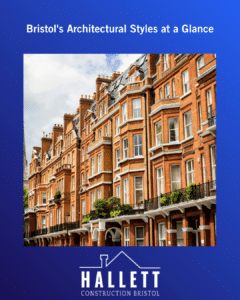
One of Bristol’s greatest strengths is the remarkable variety of architectural styles found across the city.
| Period | Style | Examples |
| Norman | Romanesque | Great Gatehouse, Bristol Cathedral (origins) |
| Medieval | Gothic | St Mary Redcliffe, Bristol Cathedral |
| Georgian | Classical | Bristol Old Vic, Victoria Rooms |
| Victorian | Gothic Revival & Industrial | Temple Meads, Cabot Tower |
| Edwardian | Civic Architecture | Central Library |
| Twentieth Century | Gothic Revival | Wills Memorial Building |
| Modern | Brutalist | Clifton Cathedral |
| Contemporary | Adaptive Architecture | Easton Jamia Mosque redevelopment |
This blend of architectural periods is what makes Bristol such a rewarding city to explore on foot, with almost every street revealing another chapter in its long and fascinating history.
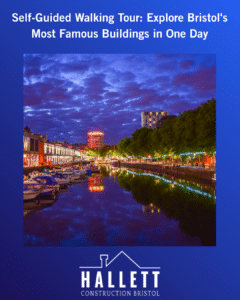
One of the best ways to experience Bristol’s architectural heritage is on foot. Many of the city’s most iconic landmarks are within easy walking distance of each other, allowing you to travel through almost 900 years of history in just a few hours.
Start your journey at College Green, where Bristol Cathedral has stood since the 12th century. Take time to admire the vaulted ceilings, cloisters and Gothic architecture before stepping outside to enjoy the peaceful green space.
Walking time to next stop: 1 minute
Next door sits the remarkably preserved Great Gatehouse, once the entrance to St Augustine’s Abbey. It’s easy to overlook, but it’s one of the oldest surviving structures in Bristol.
Opposite the Cathedral, Bristol Central Library showcases the elegance of Edwardian civic architecture. Even if you don’t venture inside, its blend of Gothic and Classical influences makes it well worth admiring.
Walking time: 8 minutes
Head towards King Street to visit the oldest continuously operating theatre in the English-speaking world. The surrounding streets are packed with independent cafés, historic pubs and beautiful Georgian buildings.
Continue towards Temple Meads Station, one of Isambard Kingdom Brunel’s greatest railway achievements. The station remains a striking example of Victorian engineering and serves as the gateway to Bristol.
Just a short walk away is one of England’s finest parish churches. The soaring Gothic architecture and intricate interior make it one of Bristol’s architectural highlights.
Walk along Bristol’s historic harbourside to discover Brunel’s revolutionary steamship. While technically not a building, it’s impossible to understand Bristol’s history without visiting this engineering masterpiece.
Finish your tour with the climb to Cabot Tower in Brandon Hill Park. After climbing the spiral staircase, you’ll be rewarded with one of the best panoramic views of Bristol.
Behind Bristol’s famous landmarks are some of Britain’s most influential architects and engineers.
Few people have influenced Bristol as profoundly as Brunel. His work transformed transport during the Victorian era and helped establish Bristol as a centre of engineering excellence.
His Bristol legacy includes:
Today, Brunel remains one of Britain’s greatest engineers, and his work continues to define the city’s identity.
Responsible for the magnificent Wills Memorial Building, Oatley created one of the last great Gothic Revival buildings in Britain, giving the University of Bristol its most recognisable landmark.
The architect behind Kings Weston House, Vanbrugh’s dramatic Baroque style helped shape some of Britain’s grandest country houses.
One of Britain’s most celebrated twentieth-century architects, Holden designed Bristol Central Library, successfully blending Edwardian elegance with medieval influences.
These buildings aren’t simply tourist attractions—they continue to play an important role in the city’s identity.
They:
Many also continue serving their original purpose, whether as places of worship, theatres, educational buildings or transport hubs.
The oldest surviving major building is Bristol Cathedral, founded in 1140 as St Augustine’s Abbey. The nearby Great Gatehouse, dating from around 1170, is another exceptionally well-preserved medieval structure.
The Clifton Suspension Bridge is widely regarded as Bristol’s most iconic landmark and is recognised around the world as one of Britain’s greatest engineering achievements.
Isambard Kingdom Brunel’s most famous Bristol projects include:
Together, these landmarks helped transform Victorian engineering.
Many of Bristol’s best-known landmarks can be enjoyed free of charge, including:
Some attractions, such as the SS Great Britain, require paid admission.
Bristol features an impressive mix of:
Few UK cities display such a broad range of architectural styles within a relatively compact city centre.
Spring and early autumn provide comfortable walking weather and excellent natural light for photography. Early mornings are ideal if you want to avoid crowds around the city’s most popular landmarks.
Bristol’s skyline tells the story of a city that has continually reinvented itself. From medieval churches and Norman gateways to Victorian engineering marvels and bold examples of modern architecture, every landmark reflects a different chapter in Bristol’s remarkable history.
Whether you’re admiring the soaring Gothic vaults of Bristol Cathedral, standing beneath Brunel’s Clifton Suspension Bridge or exploring the harbourside around the SS Great Britain, these buildings offer far more than impressive façades. They reveal how trade, innovation, religion, education and culture have shaped one of Britain’s most distinctive cities.
Exploring these landmarks isn’t simply about appreciating beautiful architecture; it’s about understanding the people, industries and ideas that transformed Bristol into the vibrant city it is today.
Historic buildings are a reminder that exceptional construction stands the test of time. At Hallett Construction, we take inspiration from Bristol’s architectural heritage while delivering modern building, renovation and extension projects that combine traditional work with contemporary standards.
Whether you’re restoring a period property, planning a home extension or transforming your living space, our experienced team is committed to creating high-quality homes built to last.
Get in touch with Hallett Construction to discuss your next project and discover how expert work can bring your vision to life.